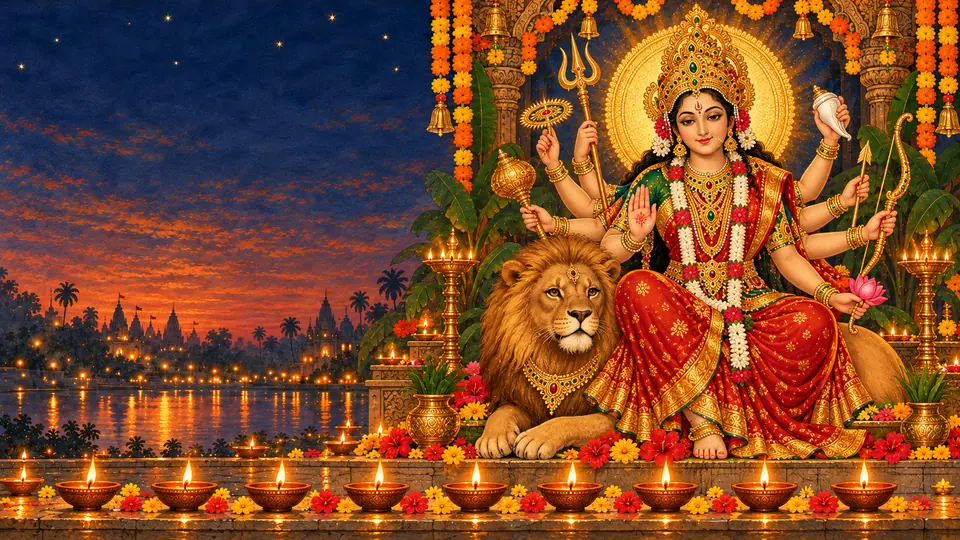
Goddess Durga seated beside a gentle lion with lit diyas and marigold garlands on a riverside at dusk.

Nine nights of the Goddess · Pratipada of Ashwin Shukla Paksha

नवरात्रि

Navratri 2026 and 2027

Shardiya Navratri · Nine nights of Goddess worship · Two-year festival guide

Nine nights to slow down, to gather, and to feel held.

नौ रातें, ठहरने की, साथ आने की और थामे जाने के एहसास की।

NextGhatasthapana: Thursday, September 30, 2027

With family, in your own language

How families keep Navratri

Navratri honours the Goddess in her many forms over nine nights. Many families fast or eat simple food, set up a kalash, read the Devi stotras and gather in the evening for aarti, garba or dandiya. Practices differ widely by region and family.

If you are not sure what to do

Keep it simple: light a lamp each evening, offer a flower and sit quietly for a few minutes. Do what is comfortable for your health, and follow your family's practice.

A small intention for these nine nights

Choose one small daily habit and keep it for nine days: a short prayer, a walk, or a kind word.

Find your Moon sign

परिवार नवरात्रि कैसे मनाते हैं

नवरात्रि में नौ रातों तक देवी के विभिन्न रूपों का पूजन होता है। कई परिवार व्रत रखते हैं या सादा भोजन करते हैं, कलश स्थापित करते हैं, देवी स्तोत्र पढ़ते हैं और शाम को आरती, गरबा या डांडिया के लिए साथ जुटते हैं। परंपराएँ क्षेत्र और परिवार के अनुसार काफ़ी अलग होती हैं।

समझ न आए कि क्या करें

सरल रखिए: हर शाम एक दीप जलाइए, एक फूल चढ़ाइए और कुछ मिनट शांत बैठिए। अपनी सेहत के अनुसार जो सहज हो वही कीजिए और परिवार की रीति का पालन कीजिए।

इन नौ रातों के लिए एक छोटा संकल्प

एक छोटी रोज़ की आदत चुनिए और नौ दिन निभाइए: एक छोटी प्रार्थना, थोड़ी सैर या एक मीठा बोल।

अपनी चंद्र राशि जानें

Parivar Navratri kaise manate hain

Navratri mein nau raaton tak Devi ke vibhinn roopon ka pujan hota hai. Kai parivar vrat rakhte hain ya saada bhojan karte hain, kalash sthapit karte hain, Devi stotra padhte hain aur shaam ko aarti, garba ya dandiya ke liye saath jutte hain. Parampara kshetra aur parivar ke anusaar kaafi alag hoti hai.

Samajh na aaye ki kya karein

Saral rakhiye: har shaam ek deepak jalaiye, ek phool chadhaiye aur kuchh minute shaant baithiye. Apni sehat ke anusaar jo sahaj ho wahi kijiye aur parivar ki reet ka paalan kijiye.

In nau raaton ke liye ek chhota sankalp

Ek chhoti roz ki aadat chuniye aur nau din nibhaiye: ek chhoti prarthana, thodi sair ya ek meetha bol.

Apni Chandra rashi jaanein

Spotted a wrong word in Hindi or Hinglish? Tell us.

At a Glance

2026 Date Ghatasthapana: Sunday, October 11, 2026
2027 Date Ghatasthapana: Thursday, September 30, 2027
Tithi / Context Pratipada of Ashwin Shukla Paksha
Deity / Focus Goddess Durga / Navdurga

Festival Calendar For Both Years

2026 Observance

Ghatasthapana: Sunday, October 11, 2026

Primary guide year

2027 Observance

Ghatasthapana: Thursday, September 30, 2027

Next-year observance

Timing Note for This Festival

Durga Ashtami 2026: October 19 · Navami Homa: October 20

Why This Festival Matters

Navratri is a structured devotional period, not a one-day festival. Its force comes from discipline across nine nights, each deepening the movement from instability toward protection, courage, and renewal. The festival becomes more meaningful when it is treated as a timing practice rather than a decorative date, because the ritual sequence, household mood, and observance window all shape how the symbolism actually lands in lived life.

Astrological Context

This observance is useful for people who respond well to phased ritual practice rather than a single ceremonial moment.

Major Planetary Backdrop

2026 Festival Sky

On this festival date, the major background is Sun in Virgo, Jupiter in Cancer, Saturn in Pisces, and the Rahu-Ketu axis in Aquarius-Leo. That combines discipline, devotion, and protection through sustained practice with the sign themes of cleanup, detail, service, and practical correction, home, nourishment, emotional continuity, and protection, and closure, surrender, imagination, and spiritual processing. For festival reading, this matters most as a background tone rather than as a separate prediction headline.

Sun in Virgo

Sun puts the visible focus on cleanup, detail, service, and practical correction. That makes the festival tone more outwardly concerned with the festival's focus on discipline, devotion, and protection through sustained practice.

Jupiter in Cancer

Jupiter expands home, nourishment, emotional continuity, and protection. That usually supports the wiser, more generous side of the festival's focus on discipline, devotion, and protection through sustained practice.

Saturn in Pisces

Saturn tests and structures closure, surrender, imagination, and spiritual processing. That adds seriousness, responsibility, and karmic weight around the festival's focus on discipline, devotion, and protection through sustained practice.

Rahu-Ketu axis: Aquarius / Leo

Rahu in Aquarius intensifies systems, networks, reform, and collective pressure, while Ketu in Leo strips back visibility, leadership, creativity, and confidence. On a festival day, that axis is best read as a reminder to keep the ritual purposeful instead of scattered.
2027 Festival Sky

On this festival date, the major background is Sun in Virgo, Jupiter in Leo, Saturn in Aries, and the Rahu-Ketu axis in Capricorn-Cancer. That combines discipline, devotion, and protection through sustained practice with the sign themes of cleanup, detail, service, and practical correction, visibility, leadership, creativity, and confidence, and direct action, initiative, and bold fresh effort. For festival reading, this matters most as a background tone rather than as a separate prediction headline.

Sun in Virgo

Sun puts the visible focus on cleanup, detail, service, and practical correction. That makes the festival tone more outwardly concerned with the festival's focus on discipline, devotion, and protection through sustained practice.

Jupiter in Leo

Jupiter expands visibility, leadership, creativity, and confidence. That usually supports the wiser, more generous side of the festival's focus on discipline, devotion, and protection through sustained practice.

Saturn in Aries

Saturn tests and structures direct action, initiative, and bold fresh effort. That adds seriousness, responsibility, and karmic weight around the festival's focus on discipline, devotion, and protection through sustained practice.

Rahu-Ketu axis: Capricorn / Cancer

Rahu in Capricorn intensifies structure, duty, endurance, and long-range work, while Ketu in Cancer strips back home, nourishment, emotional continuity, and protection. On a festival day, that axis is best read as a reminder to keep the ritual purposeful instead of scattered.

Deeper Astrological Context

This observance is useful for people who respond well to phased ritual practice rather than a single ceremonial moment. In chart terms, this kind of observance tends to become more potent when the Moon is steady, the relevant deity or planet is active by dasha, and the household is not moving through severe transit pressure. That does not mean the festival should be skipped during difficult periods; it means the ritual can be used more consciously as a stabilizing response to timing.

What to Do and When

  1. Begin with a deliberate Ghatasthapana or devotional intention.
  2. Keep the nine-day rhythm consistent instead of performative.
  3. Treat Ashtami and Navami as the spiritual high points of the cycle.

Remedies and Spiritual Practices

  • Offer steady prayer instead of scattered effort.
  • Keep the home altar or sacred space clean for the full cycle.
  • Choose one form of service, fasting, or mantra and sustain it.

Why The Ritual Sequence Matters

The practical steps of preparation, offering, and closure matter because they move the mind from casual celebration into deliberate participation. Cleaning the space, observing the correct window, and making offerings with calm attention are not only symbolic gestures; they create the internal focus that allows the festival to function as a real astrological and devotional reset.

Frequently Asked Questions

Timing matters because Navratri 2026 is tied to a specific tithi, solar condition, or ritual window rather than being only a social occasion. The observance becomes stronger when the household follows the right symbolic sequence instead of treating the date as interchangeable with any convenient day.

No. A public festival can still be observed sincerely with the right date, basic Panchang awareness, and a clean household intention. A personal chart only becomes necessary if you want to connect the observance more specifically with your current dasha, transit pattern, or family timing concerns.

The most common mistake is reducing the festival to outward display while ignoring the actual observance logic. When the ritual is rushed, noisy, or disconnected from the timing window, the astrological symbolism becomes weaker even if the visible celebration looks impressive.

Related Festivals

Festival Horoscope by Sign

Need the city-specific Panchang behind this observance?

Open Panchang